
Place
Mendoza
Argentina's most famous wine province is far more varied than the phrase “high-altitude Malbec” suggests. The useful clue is to look past Mendoza on the front label and ask which part of Mendoza the wine actually comes from.
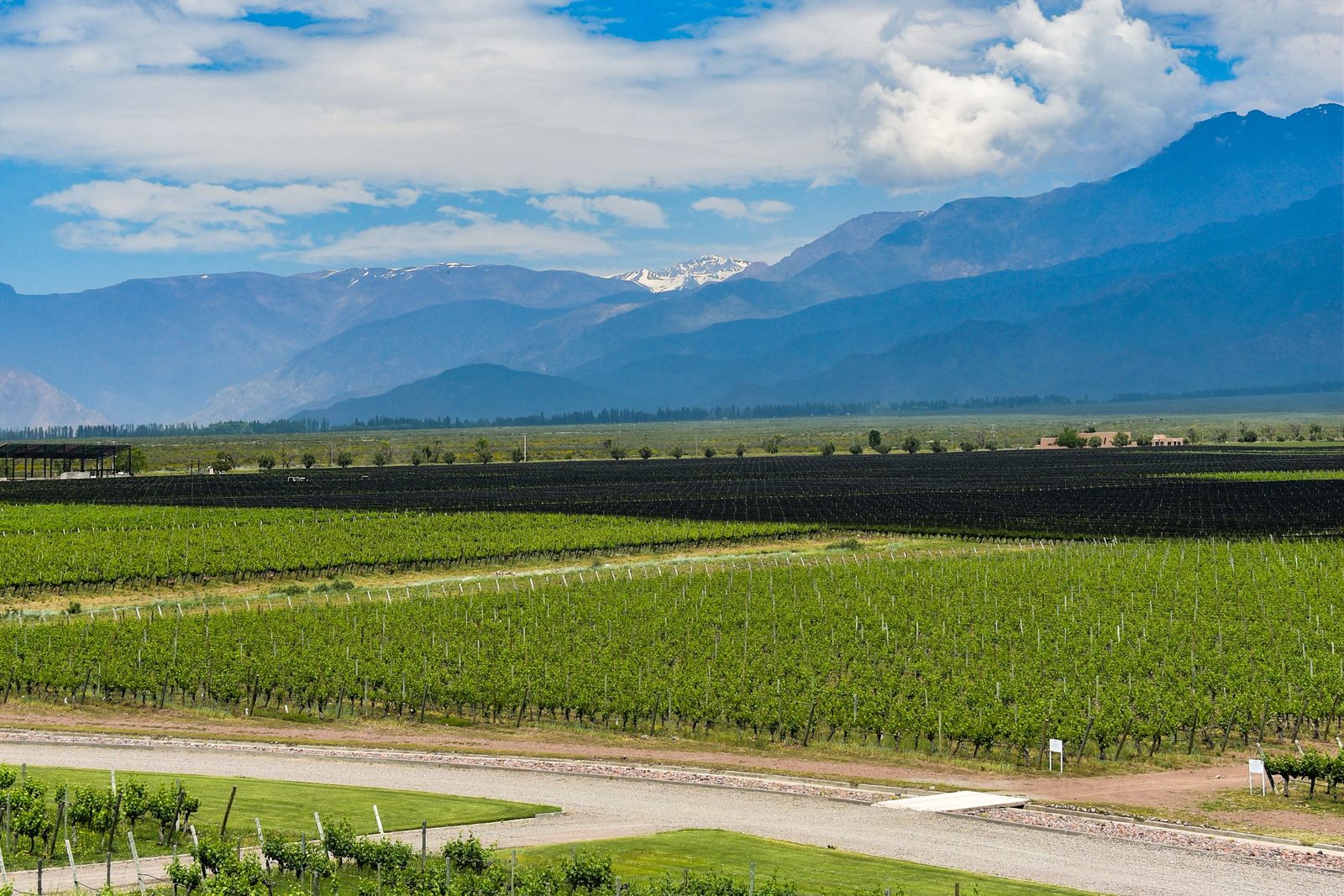
The short version
Mendoza is the name most people learn first in Argentine wine.
That is sensible.
It is also where the simplification begins.
The shorthand goes something like:
Mendoza. Andes. Altitude. Malbec.
None of those words is wrong.
Together, they can make a very large and varied wine province sound like one vineyard.
The useful way into Mendoza is to treat the word as the beginning of the address, not the end.
The grape that matters
Malbec is the obvious starting point.
Mendoza helped turn it into Argentina's international calling card, and the grape can give dark fruit, violet-like perfume, generous body and a wide range of tannin depending on site and winemaking.
But there is no single Mendoza Malbec.
Some wines feel broad and plush.
Others feel fresher, more floral or more tightly structured.
Cabernet Sauvignon, Cabernet Franc, Chardonnay and many other grapes also matter across the province.
So the place should not be reduced to one grape.
It is simply the grape through which many drinkers first meet the place.
Mendoza is not one zone
Argentina's national wine authority divides Mendoza into several areas:
North
Central
East
South
and
Uco Valley.
Within those are names that increasingly appear on bottles.
Luján de Cuyo and Maipú sit within the Central area.
The Uco Valley includes Tupungato, Tunuyán and San Carlos.
You do not need to memorise the administrative map.
You do need to notice when a producer gives you a more specific origin than Mendoza.
That extra word is often worth reading.
What altitude actually tells you
Altitude matters in Argentine wine.
It can change temperature patterns, sunlight exposure and the growing season.
But “high altitude” has become such effective marketing language that it can sound like a quality classification.
It is not.
A vineyard does not become great because its elevation is impressive on paper.
Altitude interacts with latitude, exposure, soil, water, farming, harvest decisions and the producer's style.
Use altitude as context.
Not as a score.
Why the Andes matter
Argentina's western wine regions sit along the Andes, and Mendoza belongs to the arid Cuyo zone.
That creates a very different agricultural setting from a green, rain-fed European vineyard.
The mountain landscape is not just scenery on a label.
It forms part of the climatic and water context in which the vines are grown.
But again, Mendoza is too large for one neat “Andes effect”.
Different zones and sites experience that context differently.
How to read it on a label
When a bottle says Mendoza, ask:
Does it get more specific?
Look for a valley.
A department.
A district.
A vineyard.
If it says Uco Valley, you know more than if it says only Mendoza.
If it says Luján de Cuyo, you know more again about the wine's origin.
More specific does not automatically mean better.
It means the producer is giving you a more precise address.
That makes future comparison possible.
If you already like
If you already drink Malbec, stop asking only:
Which Malbec do I like?
Ask:
Which Mendoza do I like?
Put a broad Mendoza bottling next to something from Uco Valley or Luján de Cuyo.
Notice:
the freshness,
the perfume,
the tannin,
the weight,
the oak,
the finish.
You are not trying to prove that one zone is superior.
You are turning a grape preference into a place preference.
That is much more useful.
The thing to remember
Mendoza is famous enough to feel specific.
It is not.
Remember:
Mendoza is the province. Look for the next part of the address.
That is the step that turns “I like Argentine Malbec” into actual discovery.