
Journal
Why wine lists make normal people feel stupid
You can be perfectly capable of choosing dinner, booking a hotel and running your own life. Then somebody hands you a wine list and suddenly you need to know what Volnay means.
There is a particular kind of silence that descends when the wine list arrives.
Everyone was getting on perfectly well. Food has been ordered. Conversation is flowing. Then a folder lands on the table containing 180 wines, six countries, twelve vintages and prices ranging from £38 to somewhere around the cost of a weekend away.
Someone says, “You choose.”
Nobody wants to choose.
This is strange. Wine is supposed to be one of the pleasurable parts of dinner. Yet choosing it can feel less like deciding what you want to drink and more like being unexpectedly asked to demonstrate what you know.
The problem is not that people are stupid.
The problem is that many wine lists ask the reader to solve the wrong problem first.
You want a drink. The list gives you a filing system
Think about what you actually want to know when ordering wine.
Will we like it? Is it light or rich? Will it work with what we are eating? Is £55 reasonable for this? Will everyone at the table drink it? Is it interesting without being strange?
Now look at what a traditional wine list might give you: producer, cuvée, appellation, vintage, region, country, price.
All useful information, but only if you know how to translate it.
A line saying “Domaine X, Morgon, Côte du Py, 2023” can contain plenty of information for someone who already understands Beaujolais, Gamay, Morgon and what Côte du Py tends to imply.
For everybody else, it may as well say: here is a wine. £62. Good luck.
Wine knowledge has an awkward second layer
There are really two kinds of knowledge involved in choosing wine. There is what you actually know. Then there is how confident you feel that you know enough.
Research into restaurant wine buying has found that subjective wine knowledge, essentially how knowledgeable people believe themselves to be, can matter strongly to their intention to order wine.
You do not need to know everything about Burgundy to order Burgundy. You need to feel sufficiently confident that choosing it will not end badly.
And wine comes with an unusually visible consequence if you get it wrong.
Order a disappointing side dish and nobody thinks much of it. Order an £85 bottle that nobody likes and it sits in the middle of the table for the next two hours like evidence.
Research on perceived risk in wine buying identifies more than financial or taste risk. Social and self-esteem concerns can enter the decision too.
Part of the question can become: what if I choose badly in front of everyone?
Now the wine list is doing more than helping you buy a drink. It is quietly asking you to perform competence.
Price becomes useful when everything else is opaque
So people reach for clues.
Price is an obvious one. You may not know the difference between two producers from the Northern Rhône, but you understand £48 and £96.
Perhaps the more expensive one is better. Perhaps £60 is the safe middle. Perhaps the second cheapest looks less embarrassing than the cheapest.
None of these is a particularly good way to work out which wine you will enjoy.
But when the rest of the information requires specialist knowledge, price becomes one of the few pieces of the list that everybody can decode.
Recognition works similarly. A grape, region, producer or brand you know reduces uncertainty because at least one part of the decision is familiar.
That is why someone can spend ten minutes looking at an extraordinary independent wine list and eventually say, “Shall we just get the one we know?”
This is not necessarily a failure of curiosity. It is often a success of certainty.
Asking the sommelier should solve this
And often it does.
A good sommelier can perform the translation that the list does not.
You say, “We want a red, nothing too heavy, around £60, and we would like something we probably haven’t tried before.”
That is useful information. A good sommelier does not need you to arrive knowing the appellation.
The difficulty is that asking for help can itself feel like another wine test. Do I admit I do not know the grapes? Is £50 embarrassingly low here? What does “interesting” mean to a sommelier? Am I about to be sold something more expensive?
People who are already confident with wine may enjoy this conversation. People who are not can experience it very differently.
Which creates a ridiculous situation: the person employed to make wine easier to choose can be most intimidating to exactly the person who needs the help.
That is not an attack on sommeliers. Good service is one of the best solutions.
More tasting notes will not necessarily save us
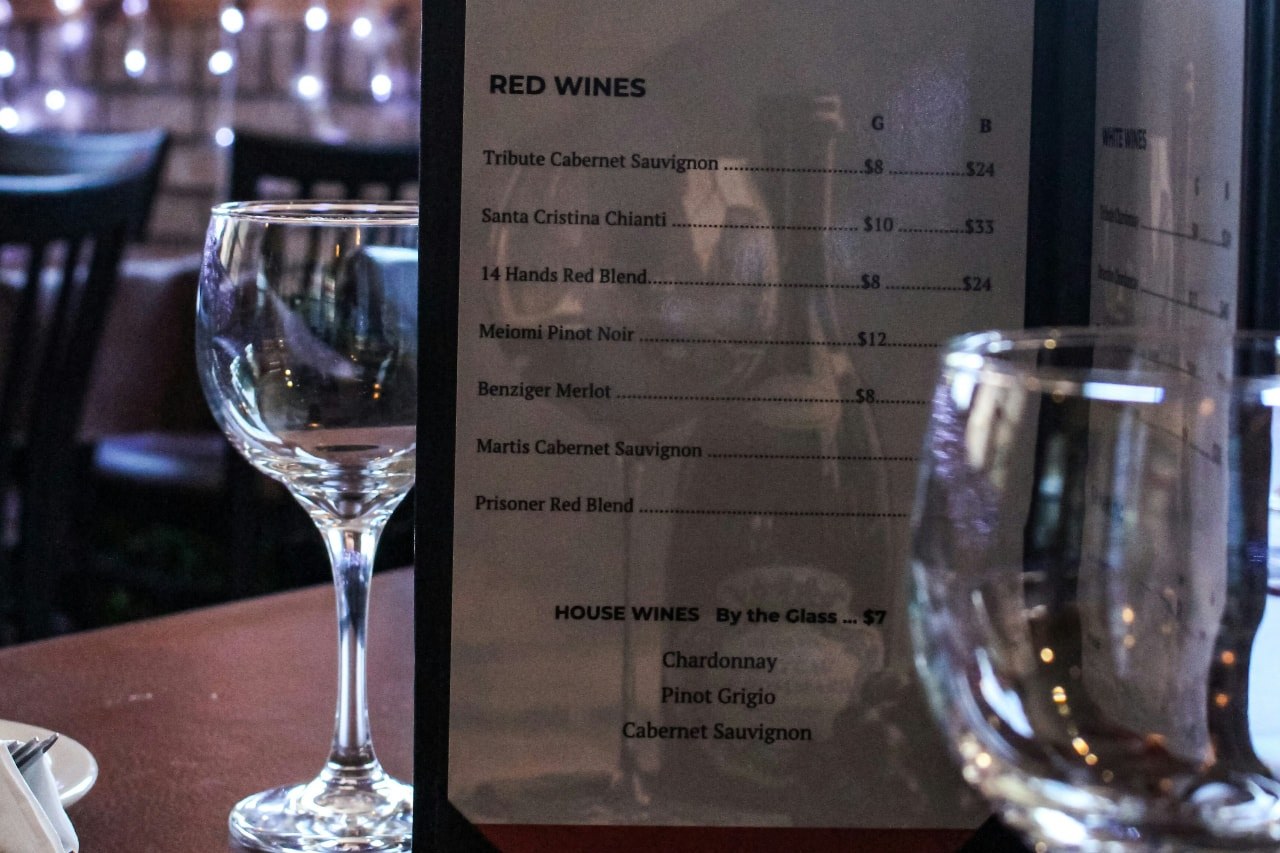
The obvious fix is to explain every wine. Add three tasting adjectives. Give every bottle a food pairing. Organise the list into categories such as “Fresh & Crisp” and “Bold & Fruity”.
Sometimes that helps.
But the research is more interesting than that.
A Swiss study compared traditional wine lists organised by origin with lists organised by wine style. More than half of participants preferred the style-based version when they could compare the two.
Promising. But the style-based list did not simply eliminate perceived difficulty, and participants took longer to choose in one part of the study.
So translating wine into more human language can help, but changing the headings is not enough.
The deeper problem is the assumption underneath the list.
The list starts with the wine. You start with your evening
Wine professionals naturally think about wine through wine: region, producer, vintage, grape, classification, winemaking.
The person sitting at table 14 might be thinking: it is Friday. We are having pasta. My friend does not like heavy reds. I would like something better than what I drink at home. I do not want to spend £100. I want to enjoy it without discussing it for twenty minutes.
Both ways of thinking are legitimate.
But only one describes the job the wine is actually being asked to do.
Instead of beginning with “What wine do I know?”, begin with “What do I want this bottle to be like?”
Light or substantial? Fresh or rich? Familiar or something new? Just for dinner, or a bottle you want to pay attention to? £40 or £80?
Suddenly you have a useful brief.
We do not need to dumb wine down
The answer is not to erase Burgundy, Barolo or Mosel from wine lists and replace everything with “YUMMY RED”.
Wine has complexity because there is complexity there. Place matters. Grape matters. Producer matters. Vintage can matter enormously.
Removing all of that would make wine less interesting, not more accessible.
The problem comes when specialist information is treated as the entry requirement rather than the explanation.
Tell me first why I might care. Then tell me it is Nerello Mascalese grown on Etna.
Now the unfamiliar name adds something. It is no longer a password.
Expertise belongs on the restaurant’s side of the table
The best wine lists already understand this.
They give knowledgeable drinkers room to go deep without leaving everybody else stranded at the surface. They use staff well. They make price clear. They give useful clues without drowning wines in marketing copy.
Most importantly, they understand that expertise belongs on the restaurant’s side of the table.
The customer should not need to earn the right to order well.
That principle applies beyond restaurants. Wine shops, labels, websites and recommendation systems all face the same choice.
They can begin with how the wine industry stores knowledge, or with how people actually decide what they want to drink.
The second route does not make wine less serious.
It just stops confusing difficulty with sophistication.
And dinner is better when nobody has to pass an exam before the bottle arrives.
Sources
- Wine & Spirit Education Trust, “How to read a wine list in a restaurant or bar”, 2022.
- Cornelia Staub and Michael Siegrist, “Rethinking the wine list: restaurant customers’ preference for listing wines according to wine style”, International Journal of Wine Business Research 34(3) (2022), 447–465, DOI 10.1108/IJWBR-06-2021-0034.
- Ji-in Yang and Jinkyung Choi, “Does Knowledge of Wine Affect Consumers’ Wine Purchase Behavior in Restaurants?”, Beverages, 2022.
- Johan Bruwer, Antonio Perez and Justin Cohen, “Restaurants and the single-serve wine by-the-glass conundrum: Risk perception and reduction effects”, International Journal of Hospitality Management 62 (2017), 43–52, DOI 10.1016/j.ijhm.2016.12.002.
- Johan Bruwer and Justin Cohen, “Restaurants and wine by-the-glass consumption: Motivational process model of risk perception, involvement and information-related behaviour”, International Journal of Hospitality Management 77 (2019), 270–280, DOI 10.1016/j.ijhm.2018.07.006.
- “Wining and dining out: on understanding restaurant wine lists”, Food, Culture & Society, 2024.
Read next
Guide
How to choose from a restaurant wine list
You do not need to understand the whole list. Decide what you want the wine to do, set the budget, give one useful reference, and let the rest of the information narrow the choice.
Journal
Gen Z is drinking. Wine still has to earn its place.
The easy story is that younger adults have stopped drinking. Current data is more awkward: legal-drinking-age Gen Z participation in alcohol has risen, while wine still faces a recruitment and relevance problem. The distinction matters.
Learn
How to read a wine label without learning another language
Most wine labels contain more information than you need and less explanation than you want. Start with six things: who made it, where it comes from, the grape if shown, the vintage, any useful local style term and the alcohol level.